- The Recap AI
- Posts
- Google and Meta team up to challenge Nvidia
Google and Meta team up to challenge Nvidia
PLUS: OpenAI's huge funding gap, HP's AI-powered layoffs, and Deloitte's second AI scandal

David Roberts
November 27, 2025
In partnership with

Good morning, AI enthusiast.
A potential new alliance between Meta and Google is poised to challenge Nvidia's long-standing dominance in the AI hardware market. Reports suggest Meta is in talks to use Google's custom AI chips for its massive infrastructure needs.
The move could significantly alter the landscape, offering a major alternative to Nvidia's GPUs for the first time. But with Nvidia claiming its platform is a generation ahead, can this partnership truly break the company's near-monopoly on AI compute?
In today’s AI recap:
Google and Meta team up to challenge Nvidia
OpenAI’s massive funding shortfall
HP's AI-powered layoffs
8 trending AI Tools
Google's AI Chip Challenge
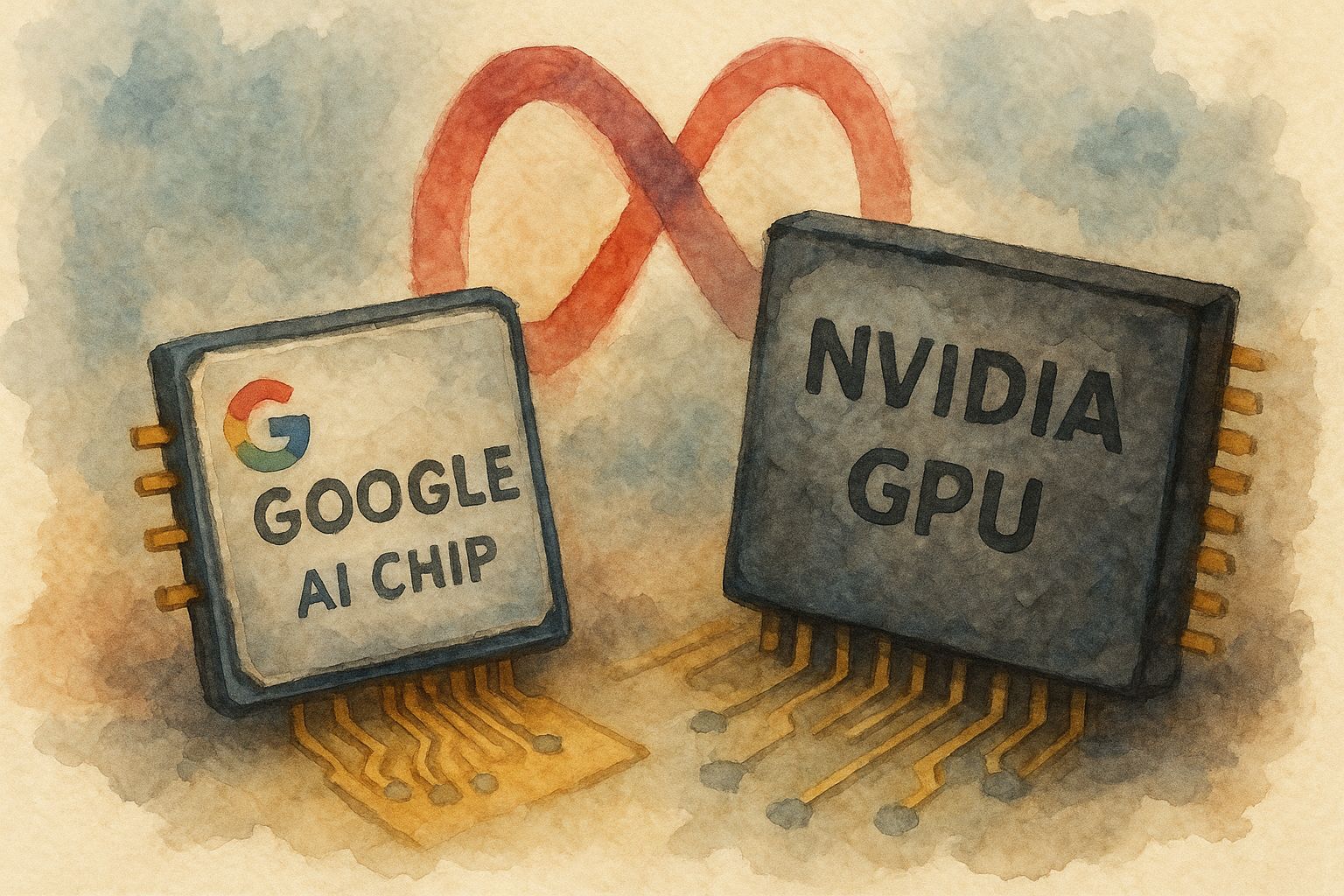
The Recap: Reports that Meta is in talks to use chips made by Google are sending shockwaves through the industry, posing the most significant threat yet to Nvidia's dominance in the AI hardware market.
Unpacked:
The potential multi-billion dollar deal would give Meta a powerful alternative to Nvidia's GPUs, reducing its dependency on a single supplier for its massive AI infrastructure needs.
Nvidia quickly responded to the news, stating on X that its platform is "a generation ahead of the industry" and is the only one that runs every type of AI model.
The move signals a major strategic shift for Google, potentially expanding its custom Tensor Processing Units (TPUs) beyond its own cloud services to power external data centers for the first time.
Bottom line: This potential alliance signals the beginning of serious competition in the AI hardware space, which has been almost entirely dominated by Nvidia. For developers and companies building on AI, a more competitive market could lead to lower costs, greater innovation, and more hardware choices.
Save 55% on job-ready AI skills

Udacity empowers professionals to build in-demand skills through rigorous, project-based Nanodegree programs created with industry experts.
Our newest launch—the Generative AI Nanodegree program—teaches the full GenAI stack: LLM fine-tuning, prompt engineering, production RAG, multimodal workflows, and real observability. You’ll build production-ready, governed AI systems, not just demos. Enroll today.
For a limited time, our Black Friday sale is live, making this the ideal moment to invest in your growth. Learners use Udacity to accelerate promotions, transition careers, and stand out in a rapidly changing market. Get started today.
AI Tools of the Day
🎮 nunu.ai - Train autonomous AI agents to see and interact with games like real humans for next-level quality assurance.
🤫 LipRead Pro - Extract speech from silent video footage by using an advanced AI to read lips and generate text transcripts.
⚙️ Zoo - Build the next generation of hardware design tools with a powerful API-first platform that makes CAD programmable as software.
🗃️ SQLAI.AI - Generate complex, optimized SQL queries from plain English by training an AI directly on your database schema for perfect context.
📞 Banter AI - Monetize your influence by creating a personal AI voice clone that your fans can call for interactive, real-time conversations.
🤖 Cheat Layer - Automate any business process across browsers by giving natural language instructions to your own team of autonomous software agents.
💬 Voiceflow - Design, test, and deploy advanced conversational AI agents for any channel in a collaborative, multi-LLM development platform.
📖 ToStory.ai - Generate entire comics and visual stories from a simple text prompt while maintaining perfect character consistency across every panel.
Explore the Best AI Tools Directory to find tools that will 10x your output 📈
OpenAI's $200B Question

The Recap: A new HSBC analysis reveals OpenAI could face a $207 billion funding shortfall by 2030, even with aggressive revenue growth, due to astronomical infrastructure costs.
Unpacked:
The gap stems from massive compute expenses: OpenAI faces data center rental bills approaching $620 billion annually, with total infrastructure commitments reaching $1.4 trillion over eight years.
HSBC projects OpenAI could hit $215 billion in annual revenue by 2030 with 3 billion users and 10% conversion rates, but OpenAI's own internal targets are more modest at 220 million paid subscribers from 2.6 billion weekly users.
Closing this gap requires either unprecedented capital raises, dramatic monetization acceleration through enterprise deals and advertising, or breakthrough efficiency gains in compute infrastructure.
Bottom line: The analysis underscores how capital-intensive the race to AGI has become, forcing the industry to confront whether current foundation model economics can ever be truly sustainable at scale.
AI Training

The Recap: In this video, I'm going to show you how to build an AI automation and system that's able to clone and spin your competitor's best-performing video UGC ads on Facebook and Instagram. We're going to use Gemini, Claude, and Sora 2 to power this whole AI automation in order to build up the context necessary to create the best video ad possible.
P.S. We also launched a free AI Automation Community for those looking to build and sell AI Automations — Come join us!
HP's AI-Powered Downsizing

The Recap: Tech giant HP announced plans to cut up to 6,000 jobs, or about 10% of its workforce, by 2028. The move is part of a company-wide initiative to embed AI for greater productivity and innovation.
Unpacked:
The restructuring initiative is designed to generate approximately $1 billion in gross annual savings by the end of fiscal 2028.
CEO Enrique Lores stated the company has been piloting AI for two years and sees a major opportunity to redesign core business processes.
This announcement follows a growing tech industry trend of pairing strong earnings reports with major layoffs justified by AI-driven efficiency gains.
Bottom line: HP's move signals that AI is now a central pillar of corporate restructuring, even for established tech giants. This shift shows companies are using AI not just for products, but to fundamentally re-evaluate roles and workflows for efficiency.
Where AI Experts Share Their Best Work
Join our Free AI Automation Community

Join our FREE community AI Automation Mastery — where entrepreneurs, AI builders, and AI agency owners share templates, solve problems together, and learn from each other's wins (and mistakes).
What makes our community different:
Real peer support from people building actual AI businesses
Complete access to download our automation library of battle-tested n8n templates
Collaborate and problem-solve with AI experts when you get stuck
Dive into our course materials, collaborate with experienced builders, and turn automation challenges into shared wins. Join here (completely free).
Deloitte's AI Déjà Vu
The Recap: For the second time this year, consulting giant Deloitte has been caught delivering a government-funded report with fake, AI-generated citations, raising serious questions about quality control and AI misuse in professional services.
Unpacked:
The $1.6 million Health Human Resources Plan for a Canadian province was found to contain citations for academic papers that researchers confirmed either do not exist or were falsely attributed to them.
Deloitte denies that AI was used to write the report but admitted the technology was selectively used to support a small number of research citations, echoing its response to a similar scandal in Australia.
This marks the second time the firm has been exposed for AI-generated errors this year, intensifying scrutiny over the use of AI in high-stakes consulting without proper human oversight.
Bottom line: These repeated failures risk eroding public trust in both major consulting firms and the AI tools they deploy. The incidents highlight the critical need for robust validation and human accountability when integrating AI into professional research.
The Shortlist
OpenAI responded to a lawsuit over a teen's suicide by claiming the boy misused ChatGPT and violated its terms of service, arguing his death was not caused by the chatbot but by his own actions and pre-existing conditions.
Warner Music Group settled its copyright lawsuit against AI music generator Suno, forging a new partnership that will allow users to create music with licensed WMG tracks from artists who opt into the program.
Google faced a significant security vulnerability in its new Gemini-powered AI coding tool, Antigravity, just one day after its launch, with a researcher demonstrating how its rules could be rewritten to install malware on a user's computer.
Michael Burry targeted the AI industry as his next big short, launching a blog to argue that the current AI trade is a bubble driven by skepticism over the justification for massive infrastructure spending.
Signing off,
David, Lucas, Mitchell — The Recap editorial team